
What are the key trends in experience design in 2026? According to event leaders, there are quite a few.
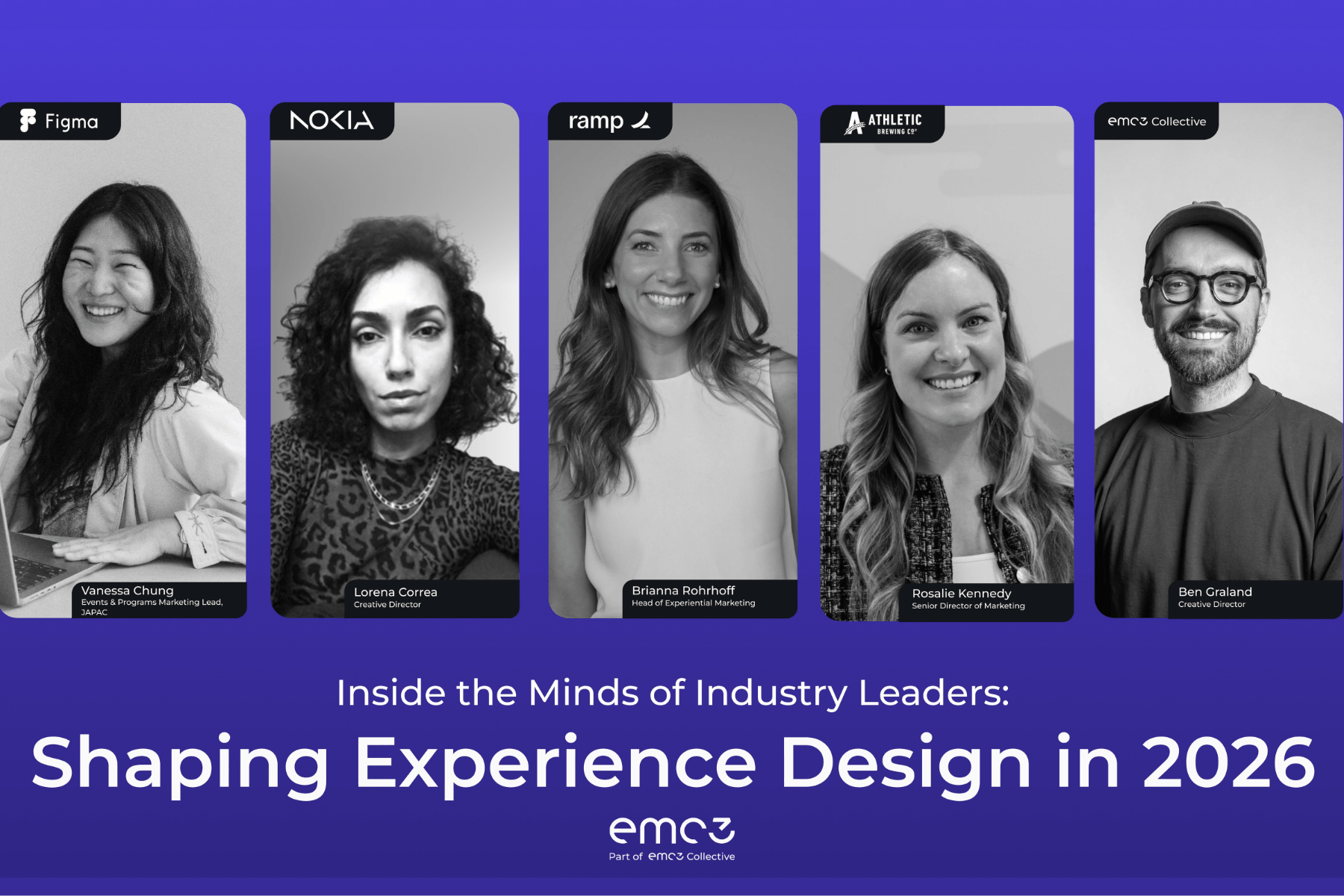
emc3 Collective spoke to industry leaders from Figma, Nokia, Ramp, Athletic Brewing Company (as well as to emc3 internally) about the most important creative decisions professionals make. The key overriding theme across all of their responses was that it isn’t about “doing more”, but about knowing where to prioritise your efforts.
From Lorena Correa, creative director at Nokia, to Vanessa Chung, events marketing lead at Figma, here are some of key areas determining event success:
- Having a clear and “singular” narrative
- Using social media to build a story pre-event
- Keeping visitors entertained during transition periods
- Putting effort into the arrival experience
- Understanding the “why” of your event
- Making sure your event is localised for your specific audience
For Lorena Correa, creative director at Nokia, the starting point is simple: “Defining a single narrative early is often underestimated.” Without it, she said, events quickly turn into “disconnected demos and messages”. Her point is that too many teams try to say too many things, and the audience ends up with none of them landing properly.
Vanessa Chung, events and programs marketing lead at Figma, points to a different problem – transitions. “A bad transition can break the vibe faster than a bad speaker,” she said. That includes everything from what’s on screens before sessions to what people are doing during breaks. Vanessa argues that if those moments feel dull, the whole experience suffers.
The arrival experience was also mentioned. Brianna Rohrhoff, head of experiential marketing at Ramp, said: “Events can be won or lost in the first five minutes.” In her case, she recalls an après-ski themed afterparty where “the moment guests entered, their phones came out… not because we asked, but because they couldn’t resist capturing it.”
One constraint mentioned was the need to prioritise what’s important over what isn’t. “Not everything can be a hero,” said Correa. Creative work becomes a process of deciding “what deserves visibility, what can be simplified, and what needs to be removed entirely.” Rohrhoff points to another challenge: “genuinely stunning creative concepts get stripped… because teams couldn’t agree on what the event was actually for.”
Running events internationally adds its own challenges. Chung said that localisation means building “a strong central concept and deliberate flex points” – consistent enough to feel joined up, but flexible enough that each city “feels like the event was made for them.”
When it comes to measuring success, most look beyond data. Chung said: “Read the room.” For others, it’s whether people “linger longer than the agenda called for”, or whether they engage without being prompted.
emc3 Collective summed it up: “What unites every perspective is the idea that memorable events are built through intention. Not by doing more for the sake of it, but by understanding what matters most, protecting the core idea and making every decision work harder.
“Whether that shows up in the way people move thro a space, the way a story carries across touchpoints, or the way guests respond without being prompted, the strongest experience design in 2026 will come through creativity that is both considered and clear.”