
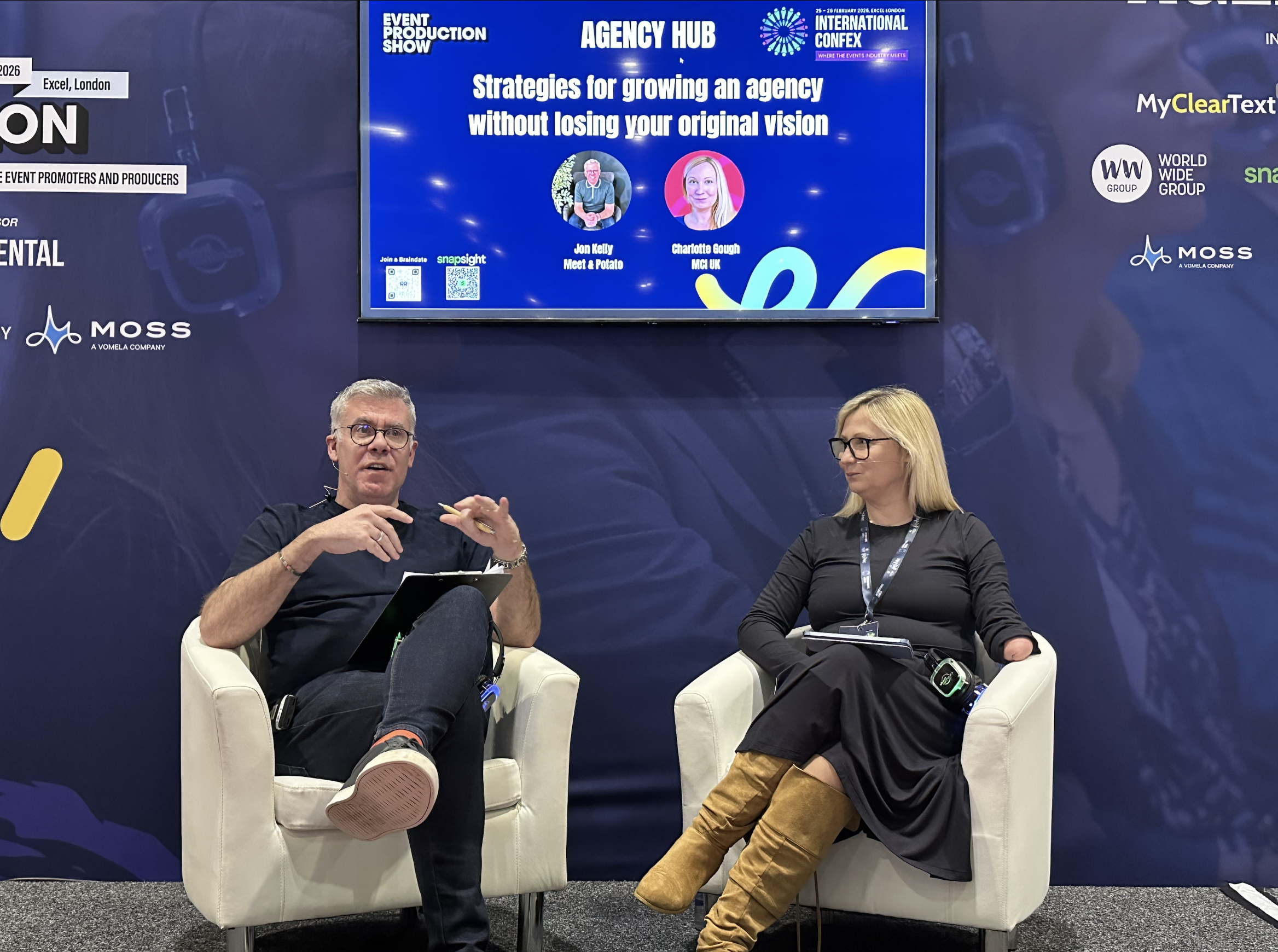
A surge in mergers and acquisitions has raised big questions about the future of events agencies.
Following on from a fireside chat hosted at International Confex last month, MCI UK’s Charlee Gough and Meet & Potato’s Jon Kelly offer perspectives from both sides of their recent deal, and share what really makes a merger work for clients and teams.
The events landscape is changing. Rising client expectations, shrinking budgets and rigorous procurement processes have affected agencies of all sizes, but for smaller players, the strain is particularly tough.
In the immediate post-pandemic years, clients were looking for agencies who could respond to their needs quickly, and that was great for small teams who could turn around a proposal fast and come in under budget. It was a buyers’ market, and boutique agencies flourished.
But fast forward a few years and everything has changed. Clients are seeking long-term strategic partnerships that have the stability and infrastructure to meet the growing demands of procurement.
“The pressure on small agencies was inevitable” – Jon
The pressure on small agencies was an inevitability, but for years we made it work. We were a successful boutique with a brilliant team and loyal clients, but every time we tried to grow, we hit a wall. Things started to be less about creativity and more about proving value and justifying cost, and we found ourselves competing with bigger agencies who could offer the layers of complexity a small team just doesn’t have.
The boutique model is powerful. It’s close-knit, creative, and hungry for success, but it can also be exhausting, and it started to feel like a hamster wheel. I wanted to give the team more stability and opportunity, so it was a question of ‘how do I change the business without losing the creativity and culture?’
“We realised organic growth wouldn’t take us where we needed to go” – Charlee
MCI UK has always been known for its associations and logistics delivery, but we knew we needed to evolve. We were concentrating on our corporate growth journey, and it just wasn’t happening quickly enough. When we realised we weren’t going to achieve that organically, exploring a strategic merger became part of that journey.
That said, we didn’t want to pursue an acquisition for the sake of it. It had to fit our direction and complement our existing team. Cultural alignment was the main driver and it took a long time, but it was important that we found the right fit. When we met with Meet & Potato, I knew it was the right fit.
“We’ve created a symbiotic relationship with MCI UK” – Jon
What Meet & Potato was lacking in infrastructure, MCI UK was lacking in corporate clout. So we came together knowing we were each bringing something to the table. That was a key factor for me. I think for smaller agencies, there’s a fear that if you get acquired, you’ll lose your soul. But it’s not always the case, and it certainly wasn’t with us. We retained the entire team, which is not always possible with M&As, but the talent we had was part of the draw.
It took two years of talks before I decided it was the right thing to do – and that’s the advice I’d give to any agency owner exploring a M&A journey. Do your due diligence and make sure you’re doing it for the right reason, with the right partner. And you can’t make that decision over a couple of meetings.
“Culture should always be your biggest green flag” – Charlee
If you bring in an agency that doesn’t fit with your culture, you’re going to have a problem. Processes and policies can be figured out later, but the people, their values and their energy need to work from the get-go. If there’s any friction at any point, it’s not going to work.
We’ve been through this twice in a very short space of time – first with M&P and then Pure Communications – and the motivator has always been a unified culture. Otherwise, integration becomes impossible.
You also need to really understand the agency you’re thinking about joining with and work collaboratively with them to understand where the crossovers and gaps are. Because those things can be blockers.
“Involve your team in the conversation” – Jon
Take your people on the journey with you. They might not understand it right away, but they will get it. Show them patience and give them an open forum to voice their concerns, otherwise you run the risk of pulling the rug from underneath them. I made a commitment to my people that this was going to be great – and I only made that promise because I believed it. I knew this was the right path forward for everyone involved.
“Some clients won’t come on the journey – but that’s ok” – Jon
You’ve got to accept that some clients won’t come with you. That hurts, but it’s just a part of growing. You’ve got to trust the process. Be honest with your clients about what you’re doing and what it means for them, and help them see the benefits. I want our clients to see that what we did will help us to deliver even better work. That we are now stronger and better as a cohesive team. But that only happens if you’re open and honest with them as early as possible.
“Integration isn’t over yet” – Charlee
I don’t think we’ve seen the end of mergers and acquisitions. There will definitely be more, and I think in the next five years you’ll see some very big players in this market. The opportunities for small boutiques are still there, but they are a lot fewer.
“M&A isn’t easy – but it can be a good thing” – Jon
There will always be smaller agencies, but I think there will be more acquisitions. My advice to agency owners would be to ask as many questions as you can and talk to someone who’s been through it.
Selling your business is hard. It’s personal. It’s emotional. You have to let go of something you built from scratch – it’s worse than a divorce in some ways. But if you believe in the future you’re building, it’s completely worth it. Change can be a good thing. It is a good thing.