

A new study from booking.com for business has revealed the ten core trends set to redefine the corporate event industry in 2026, including the growing prevalence of AI, sustainability and hybrid conferences.
This comes as the global corporate events market is set to almost double to £441 billion by 2029, underlining renewed confidence in in-person engagement.
- 58% of event professionals report increased use of AI and automation
As event volumes grow and timelines extend, AI tools are being used to streamline registration, personalise agendas, optimise schedules, and analyse attendee behaviour.
This allows planners to manage complexity at scale while maintaining lean internal teams, particularly for multi-event portfolios.
2. 66% of event planners outsournce at least part of event management
Specialist suppliers are increasingly relied upon for A/V production, event technology, sustainability compliance, and on-site execution. This reflects both the technical demands of hybrid events and the difficulty of maintaining all required expertise in-house.
- Booking lead times for large convention venues have extended to 18-24 months
Longer lead times reduce flexibility and increase financial exposure, pushing organisations to secure budgets earlier and commit to destinations well in advance. This shift favours planners with strong forecasting capabilities and encourages repeat use of trusted venues and destinations. This reduces flexibility for late decision-making and favours businesses with centralised planning, forecasting, and travel management infrastructure.
4. 83% of planners consider sustainability when planning events
Environmental considerations now influence venue selection, catering choices, supplier contracts, and travel decisions. As sustainability expectations rise among attendees and stakeholders, planners are often required to balance environmental impact with cost and operational feasibility.
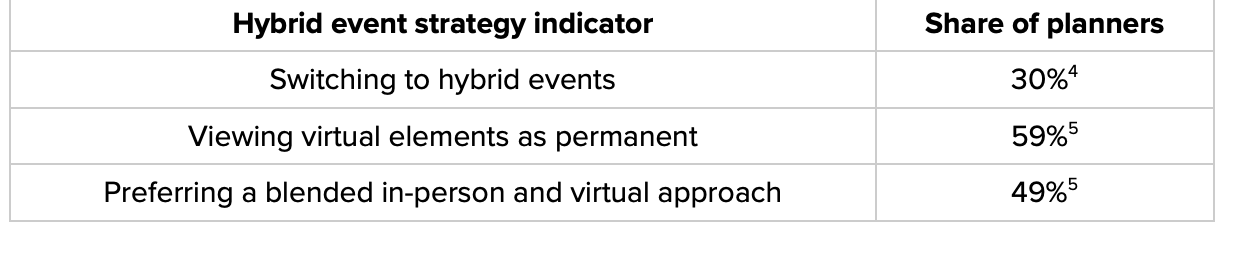
5. 80% of event planners now host or plan hybrid events as a core event format
Hybrid delivery has transitioned from a response tactic to a permanent model.
- 74% of Fortune 1000 companies plan to increase their event budgets in 2025
88% of corporate event professionals anticipate higher budgets, and 98% of meeting-planning professionals in North America expect meeting spending to grow in the future. Rising budgets reflect the role of events in generating revenue, building relationships, and fostering internal alignment, even amid broader economic uncertainty.
- 61% of organisers find hybrid events more cost-effective than in-person-only events
Hybrid events reduce the need for large venues, limit travel costs, and allow organisations to scale attendance digitally. This makes hybrid delivery particularly attractive for events with global or distributed audiences.
- Fixed costs are being spread across fewer attendees, driving up per-capita spend
As organisations shift toward higher-impact, smaller-group experiences, fixed costs such as venues, production, and event technology are being spread across fewer attendees.7 This dynamic drives up per-capita spend even when total event budgets remain flat, contributing to rising cost pressure without a corresponding increase in scale.
- 90% of planners are considering secondary markets as a cost-saving alternative
Secondary cities offer lower venue rates, better availability, and more predictable pricing. For many organisations, this shift supports budget efficiency without sacrificing attendee experience.8
- 60% of planners cite advanced AV as a top priority as experience costs rise
Cost increases are concentrated in experience-critical areas. 60% of planners report advanced A/V support as a top priority, and 33% say technology-enabled events are top of mind. These priorities reflect rising expectations around production quality, immersive experiences, and seamless hybrid delivery.
Nadine Blokker, booking.com for business expert, said: “Corporate events drive measurable business outcomes, like networking and revenue, so they must be carefully considered and planned.”
Here are some ways to make the most of every event trip
- Plan around the attendee experience: Understand your audience. Consider the session length, networking opportunities, and hybrid access options. A smooth, engaging experience increases participation and satisfaction.
- Book early and strategically: Secure venues, flights, and hotels well in advance. Mid-week travel and accommodations close to venues reduce stress, travel costs, and lost productivity.
- Leverage corporate travel management tools: Use business travel management platforms to coordinate travel, manage expenses, and streamline itineraries. For teams attending multiple events or international trips, this ensures every detail is tracked and optimised.