
By Ben McCarthy, Founder, Premier Events
Most months, this column is about one tool solving one problem. This one is different, because it’s not really about a single tool. It’s about the place all our tools finally live.
Here’s the “before” that made me actually do something about it. Requesting a day off at Premier, with a team of 55 people, used to take eight steps and three people. You’d submit a request in Xero. It would go to Charlotte, who runs our accounts and HR. She’d send it to your line manager.
Your manager would open a spreadsheet to check who else was already off that week. They’d approve it and send it back. Charlotte would approve it in Xero. She would update a master spreadsheet, add it to the relevant people’s calendars and update Current RMS, our operations system, manually as well.
We’d known for years that this needed sorting. It was fine when we were a team of 10, but the process hadn’t changed since it was introduced. We just never got round to it, client events got in the way, and the system was just inefficient.
So that’s where I started, and it’s where the wider platform grew from.
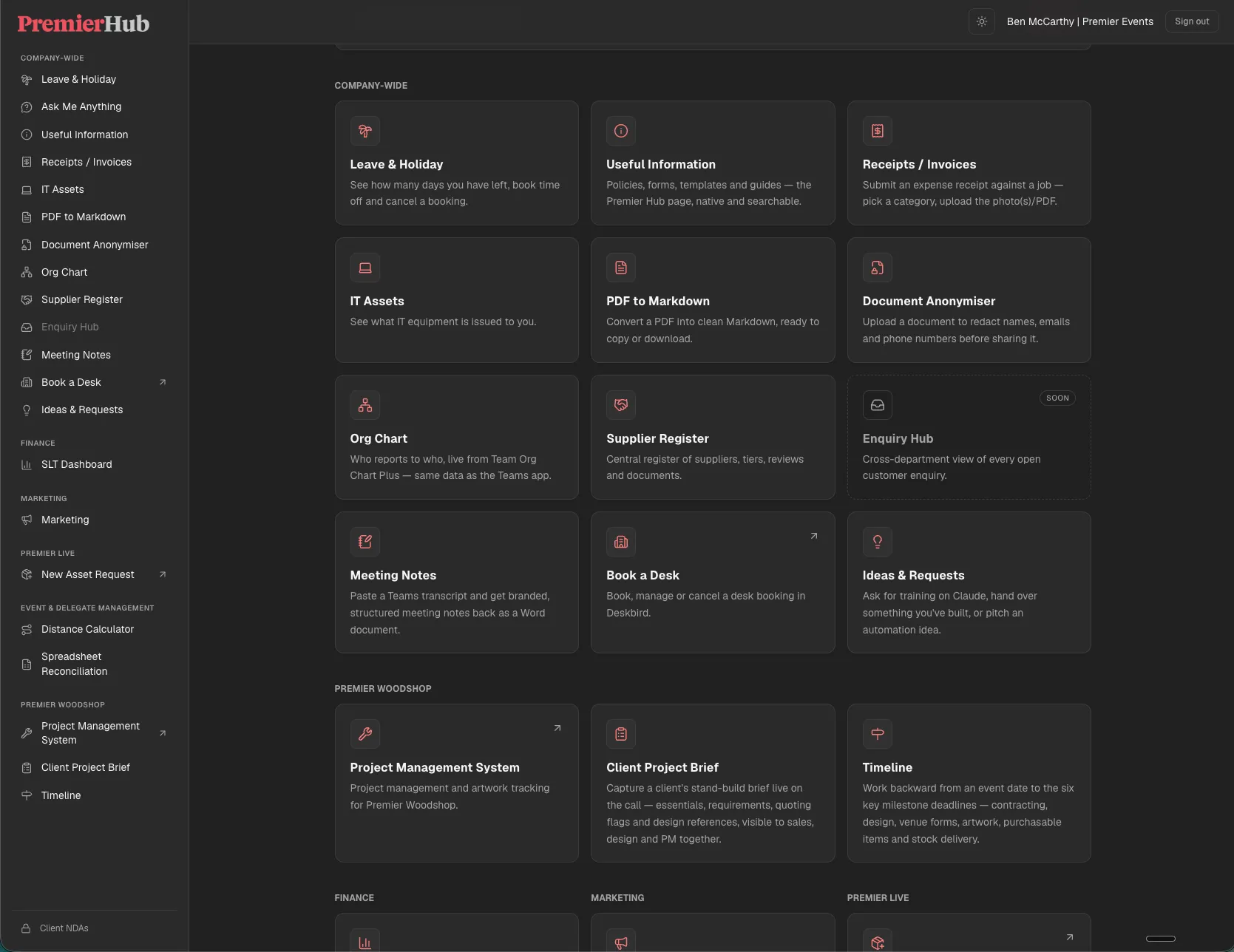
I built the Premier Hub: one site, one login using the Microsoft account everyone already has, no separate password to set up or forget.
Leave went in first. Your manager now gets a notification of a new holiday request, and sees a live view of who’s already off, no spreadsheet needed. Approvals sync to Xero on their own, and the relevant people get a calendar invite too. And there’s a genuinely new bit: you can now cancel a booked holiday yourself from the Hub.
Before, you couldn’t do that in Xero directly, so you had to email Charlotte and ask her to do it. That option didn’t exist at all until now.
The Hub runs on a server we already pay for, sat next to n8n, the automation tool that already runs most of our behind-the-scenes work, so there’s no new software subscription for finance to notice.
To be completely transparent, it’s cost around £1,000 in Claude tokens to build, on top of my own time. Set against fifty-five people no longer chasing spreadsheets, emails and Charlotte for every day off, and everything else the Hub now does across the business, that’s a number I expect to look very small within a few weeks.
But the real point of the Hub isn’t leave. It’s what happens to all the other things I build. Most months, this column describes a tool I built with AI to solve one specific problem, and every one of those tools has had the same limitation: it lived on my laptop, or in one automation only I could see, and helped whoever I happened to hand it to.
Other people at Premier have quietly done the same thing, building their own bits of AI tooling that only they could use. Good ideas, stuck on one machine.
The Hub is where that stops. It’s the shared place those tools actually belong, so a good idea built by one person becomes something the right people across the business can use, not a file on someone’s desktop.
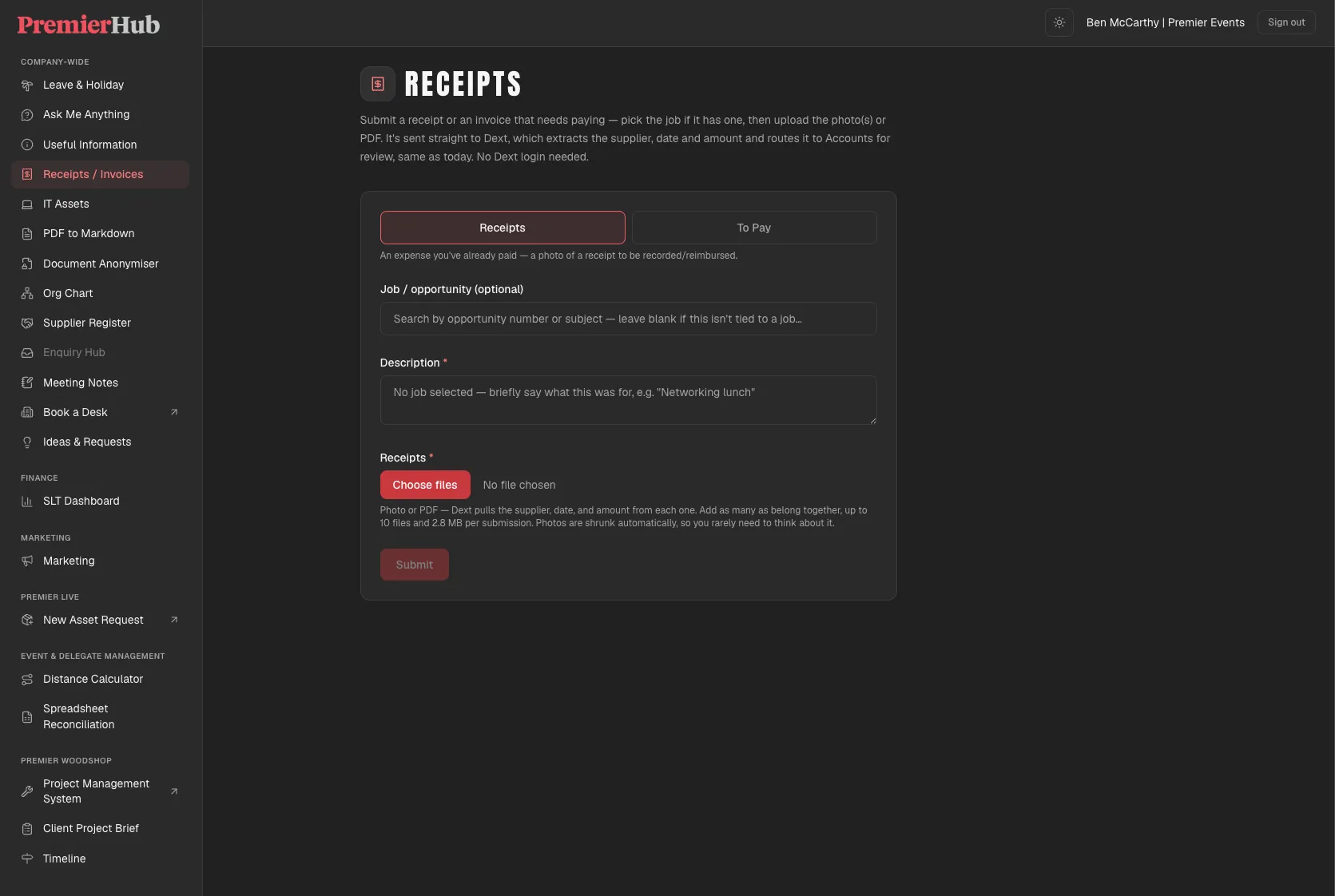
Alongside Leave, there’s a proper search for company documents that used to mean emailing someone to ask where something lived, a single register for signed NDAs that used to be scattered across folders under two different names, a page where staff can flag IT kit they already have so it actually lands on our asset register instead of nowhere, and a Receipts and Invoicing module that’s just gone live: a receipt now only needs uploading once, and it lands in both Xero and Current RMS at the same time, with the cost automatically added to the correct job.
I’m still not a developer. I’m an ex-DJ who runs an event agency, and that hasn’t changed for this build any more than it did for the smaller ones.
What changed is scale. I described each problem, checked what came back, and asked for changes when something felt wrong, the same process as every other month, just repeated across a lot more modules.
I’ve spent about three weeks building this, which is a significant amount of time, and a good chunk of it went on getting the credentials right inside n8n so the Hub could talk properly to Microsoft, Xero and Current RMS. That was the slow, unglamorous part. Now those credentials are in place, everything new we add gets noticeably quicker to build. It’s also meant checking everything we do stays compliant with ISO 27001.
If you’re sitting on a process everyone quietly hates, my honest advice is don’t design the whole platform up front. Fix the one thing that’s actually painful, ours was leave, and let everything else grow around it once people trust it works.
As I write this, I’m about to give the whole team access, so next month I’ll have real numbers on how much use it’s had and what the feedback’s been. I also want to go deeper on Receipts and Invoicing specifically, because I think it’s going to end up saving even more time than Leave did.